MLB Home Run Prop Bets: The Complete UK Guide
 Available in US
Table of Contents
- What This Guide Will Hand You in the Next Six Thousand Words
- What an MLB Home Run Prop Bet Actually Is
- How Home Run Props Are Priced
- The Five Forces Behind Every Home Run Prop
- Estimate the swing, find the value
- Reading Statcast for HR Props
- UK Operators That Offer MLB Home Run Markets
- Voiding Rules: What Happens If Your Player Doesn’t Start
- Bankroll and Staking on a Long-Odds Market
- Same-Game Parlays with Home Run Legs
- The Polymarket Era: Prediction Markets and Home Run Contracts
- Staying in Control: UK Resources for Home Run Punters
- Frequently Asked Questions
The first home run prop I ever placed was a 3 a.m. punt on Aaron Judge at +450, watching a grainy stream from a Premier Inn in Manchester. I lost. I lost the next four too, then got curious enough about why I kept losing that I spent the next eleven years pulling apart Statcast feeds, park factors, and the strange American art of pricing a single swing. This guide is what I wish someone had handed me that first night.
Home run props are the most British-friendly bet on the MLB slate, even though almost nothing written about them is aimed at us. A round-tripper is a discrete event with a fat price, no scoreboard ambiguity, and a market that the UKGC-licensed books are happy to take. You don’t need to follow 162 games. You need to read a matchup.
What I’m not going to do here is hand you tips. The UK gambling market hit £16.8 billion in gross gaming yield last reporting cycle, and most of that growth came from people convinced the next stranger on the internet had the answer. I want you reading the props yourself. So I’ll cover what the bet actually is, how the price gets built, the five forces that move the line, the Statcast metrics that matter, which UK books carry the markets, the voiding traps, how to stake long odds, and where the new Polymarket-MLB partnership fits. Skip what you already know.
What This Guide Will Hand You in the Next Six Thousand Words
- Home run props are the highest-variance bet on the MLB slate, priced typically between 2.90 and 11.00 in decimal odds, with bookmaker holds of 12 to 18 percent against the 2 to 4 percent of a Premier League moneyline.
- Five forces decide every prop: pitcher matchup, park factor (Dodger Stadium 129, PNC Park 66), weather (each 1 degree Celsius adds 1.96 percent to HR rate), Statcast signals, and lineup position.
- Stake 1 to 2 percent of a ringfenced bankroll per play, never more, and treat losing runs of seven to ten as routine rather than a crisis.
- UK punters should use UKGC-licensed sportsbooks, never a VPN to American books, and bookmark GamCare, BeGambleAware, and GAMSTOP before the first stake goes on.
What an MLB Home Run Prop Bet Actually Is
Picture the simplest bet in baseball. Will Cal Raleigh — the Seattle catcher who hit 60 home runs in 2025, the most ever by anyone at his position, by any switch-hitter, and by anyone in Mariners franchise history — clear a fence tonight? Yes or no. That’s a home run prop. Everything else in this guide is just decoration around that one binary question.
A prop, short for proposition bet, is a wager on something inside the game that isn’t the final result. The home run version is the most popular MLB prop on the British slate because the answer is unambiguous, the price is large enough to feel like a real win, and the input variables — pitcher, park, weather, hitter form — are public data you can read in twenty minutes.
The standard market is “Player to Hit a Home Run”, priced typically from around 2.90 (+200) for top sluggers in launching-pad parks out to 11.00 (+1000) or longer for fringe bench bats. Ohtani against a struggling left-hander at Dodger Stadium might come in at 2.50. A backup catcher at PNC Park against a Cy Young contender will sit at 15.00 and lose nine times out of ten.
Round-tripper — slang for a home run, referring to the four bases the hitter rounds. “Dinger”, “long ball”, “blast”, and “going yard” all mean the same thing: a fair ball landing beyond the outfield fence.
Beyond the simple yes/no there are three variants worth knowing. “First home run of the game” pays bigger because you’re betting on event and timing. “Home run in a specific inning” is longer-priced and almost always poor value. “Alternate home run line” lets you take 2+ or 3+ home runs from a single hitter at inflated prices — a gimmick I touch on later but mostly avoid.
Voiding rules are where the small print bites. American books split: DraftKings voids a home run prop if the player isn’t in the starting lineup, while FanDuel keeps the bet live for any plate appearance, including a pinch-hit. UK operators broadly follow the FanDuel pattern, but check your specific book’s MLB rules page before staking. I cover the mechanics in detail later on.
A home run prop is a binary bet on whether one named hitter will go yard in one specific game. The market is the most accessible MLB prop for British punters because the outcome is unambiguous and the price is meaningful, but the variant you pick — straight, first, alternate — changes the maths dramatically.
How Home Run Props Are Priced
Here’s the question that gets a beginner properly stuck. Why is Aaron Judge — the best power hitter alive, in a hitter’s park, against a back-end starter — priced at +250 instead of even money? The answer is the difference between probability and price, and once you see it, the entire prop market opens up.
Implied probability is the percentage chance the bookmaker is pricing into a number. The conversion from decimal odds is one divided by the odds. So 2.90 (+200) implies a 34.5 percent chance, and 5.00 (+400) implies 20 percent. That’s not what the book actually thinks. That’s what the book is paying you as if it thinks. The real probability the book has modelled is lower — sometimes meaningfully lower — and the gap is the hold, also called the margin or the vig.
Worked conversion
Decimal odds 4.00: implied probability is 1 / 4.00 = 25 percent.
Decimal odds 6.50: implied probability is 1 / 6.50 = 15.4 percent.
Decimal odds 11.00: implied probability is 1 / 11.00 = 9.1 percent.
If your own model says a hitter has a 12 percent chance and the book is offering 11.00 (9.1 percent implied), there’s value. If your model says 8 percent on the same line, there isn’t.
Most home run props sit between 9 and 35 percent implied probability. Anything shorter than +180 (35.7 percent) is a special — Judge against a soft opener at Yankee Stadium with a 25 mph jet stream blowing out — and anything longer than +1500 (6.2 percent) is a lottery line on a slap-hitter. The bulk of decisions live in the 4.00-8.00 (+300 to +700) corridor, which is where matchup analysis genuinely matters.
The hold on a home run prop is wider than on a moneyline. On a Premier League match a sharp UK book might run a 2 to 4 percent margin. On a single-name HR prop the margin is often 12 to 18 percent. That’s not a scandal — it’s the cost of the book absorbing the variance of a low-probability event — but it does mean you cannot bet home run props at random and break even.
A useful self-check before placing: convert offered odds to implied probability, then ask whether you’d take the same bet at 70 percent of that probability. If the honest answer is no, the line isn’t priced wide enough to absorb the hold. Pass.
One more wrinkle. UK books quote in decimal, US books in American — same number, different format. Decimal 2.50 equals American +150; decimal 1.67 equals -150. Learn to translate in your head. It takes a week and saves hours.
The Five Forces Behind Every Home Run Prop
I keep a paper note above my desk with five words on it: pitcher, park, weather, hitter, lineup. Every home run prop I take has to clear all five. Skip one and you’ll back a +600 lottery ticket because the price was pretty, then watch your hitter bat once because he’s the seventh-place backup against a left-handed opener. The forces compound, they don’t average.
Pitcher Matchup
The single biggest mover on a home run prop isn’t the hitter. It’s the man on the mound. A power hitter facing an extreme ground-ball pitcher will produce home runs at maybe a third of his usual rate. The same hitter facing a high-fly fastball-heavy starter who lives up in the zone is in a different bet entirely.
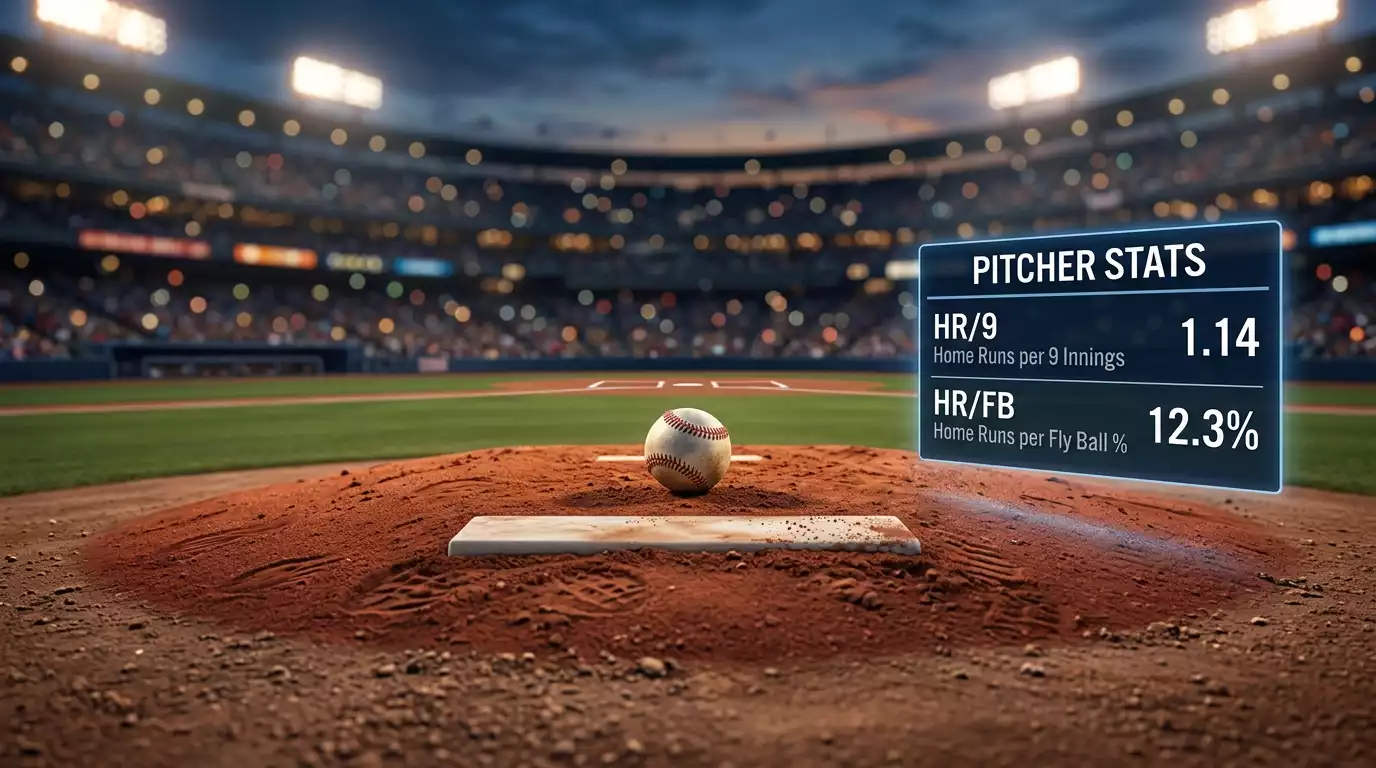
What you want from the pitcher line: home runs allowed per nine innings (HR/9), barrel rate against (the percentage of batted balls he gives up that meet the Statcast barrel definition — 98 mph minimum at 26-30 degrees), ground-ball percentage, and platoon split. A right-handed pitcher with a 1.6 HR/9 and a hard-pull lefty in the box is the bet I’m looking for. Same pitcher against a right-handed contact hitter is one I’m passing on.
Bullpen exposure matters less for HR props than for total runs. Starters throw 60-70 percent of HR-allowed innings in the modern game. If the starter is wrong for your hitter, the bullpen rarely saves the bet.
Park Factors
Park factors are the boring word for the strangest thing in baseball: the ballparks themselves are not equal. A fly ball that lands in the third row at Dodger Stadium dies on the warning track at PNC Park. Dodger Stadium currently sits at the top of the league with an HR park factor of 129 — meaning home runs are produced there 29 percent above the league average. Great American Ball Park in Cincinnati ranks second at 122. PNC Park, the most home-run-suppressing venue in the league, runs at 66.
Coors Field in Denver is the outlier nobody can explain away. The stadium sits at 5,280 feet of elevation, and the thinner air adds roughly 9 percent to flight distance compared to sea level. A 400-foot drive at Yankee Stadium travels about 408 feet in Atlanta and as much as 440 feet in Denver. Same swing, different physics.
Two parks just changed shape. Kauffman Stadium pulled the outfield walls in by 8 to 10 feet and dropped the fence height from 18.5 feet to 8.5 feet ahead of the 2026 season. T-Mobile Park ranks ninth-lowest in MLB for fence height and sixth-best for left-handed home runs in current projection systems. If you’re betting at either venue, recalibrate. Last year’s park factor is yesterday’s news.
This is one of the deepest inputs in the model and it deserves its own treatment. I cover every park, the methodology, and the 2026 changes in the park factors guide for 2026.

Weather: Temperature, Humidity, Wind
Picture the same fly ball in April and July. Same hitter, same swing, same exit velocity, same launch angle. In a 75-degree April game it dies on the warning track. In a 95-degree July game it carries over the fence. That’s not poetic — that’s the air doing different work.
The hard number, from a study of more than 100,000 MLB games stretching from 1962 to 2019, is that every 1 degree Celsius rise in game-time temperature produces a 1.96 percent increase in home runs. A game played 10 degrees Celsius warmer than the seasonal average yields almost 20 percent more home runs than the average game. The mechanism is air density. Hot air is thinner. Thinner air offers less drag. The ball flies further.
The lead author of that study, Christopher W. Callahan at Dartmouth, put the finding plainly: We can say that the same ball leaving the same bat ends up being a home run more often in warm conditions, due to reduced air density.
Since 2010, more than 500 home runs in the historical record can be attributed to climate-driven warming, with projections of 130 to 467 additional home runs per year league-wide by century’s end.
Wind moves on a daily timescale. A 5 mph tailwind adds about 19 feet to flight distance, work attributed to physicist Dr Alan Nathan at the University of Illinois — which, on a ball that would otherwise land on the warning track, is the difference between an out and a souvenir. Reading wind direction matters most at parks with asymmetric layouts and known jet streams: Wrigley Field, Yankee Stadium, Citi Field.
Humidity is the small print. Higher humidity reduces air density slightly, so all else equal humid days carry better than dry ones, but the effect is much smaller than temperature, and at climate-controlled domes the variable disappears entirely.
Park and weather set the stage. The next two forces tell you whether the man holding the bat is actually capable of using it.
Hitter Form and Statcast Signals
Recent home run total is the worst metric you can rely on. A hitter who has gone yard four times in his last seven games might be on a heater, or he might be a regression candidate who got pull-happy at three short porches. The data that survives the noise lives in Statcast.
The four signals I want green before I touch a hitter at any price: barrel rate (the percentage of batted balls meeting the 98 mph, 26-30 degree barrel definition), hard-hit rate (share of balls struck above 95 mph), pull-side fly-ball rate (because home runs at most parks happen to the pull-side), and ISO — Isolated Power, slugging minus batting average, a clean measure of extra-base output stripped of singles. Schwarber led the league in 2025 with a 59.6 percent hard-hit rate. Ohtani was second at 58.4 percent. Those numbers don’t drift; they tell you who’s actually striking the ball with home run intent.
Worth knowing: Oneil Cruz hit a ball at 122.9 mph exit velocity on 25 May 2025 — the hardest-struck home run on record in the Statcast era, which dates to 2015. The point isn’t trivia. Exit velocity has a hard ceiling per hitter, and once you know it, the alternate lines start to make sense.
I go through every metric, where to read them, and how to weight them in the dedicated Statcast for beginners guide. The summary version: form is what Statcast says it is, not what last week’s box scores suggest.
Lineup and Batting-Order Context
The fifth force is the easiest to forget and the most quietly punishing. A hitter batting third gets, on average, around 4.4 plate appearances per game. A hitter batting eighth or ninth gets about 3.6. That’s nearly a full plate appearance gap, and on a low-probability event like a home run, it shaves real percentage points off the implied chance.
Worse than batting low is not being in the lineup at all. Day-game-after-night-game schedules, second games of doubleheaders, and right-handed-pitcher rest days for left-handed power hitters all produce surprise scratches. I check the lineup the moment it posts — usually two to three hours before first pitch — and never stake before lineups are out unless the price is so wide it survives a worst-case scratch.
If your hitter batted ninth yesterday and the manager has telegraphed a day off, the +600 you saw at lunchtime is a different bet at 9 p.m. when he’s confirmed batting cleanup. Markets shift on lineups. Watch the line move; it’s free information.
Estimate the swing, find the value
| Losing run | Bankroll left | Verdict |
|---|
Reading Statcast for HR Props
The first time someone showed me a Baseball Savant page in 2014 I thought it was a fake dashboard. Twelve cameras tracking every pitch and every swing across every park, returning exit velocities to the tenth of a mile per hour and launch angles to the degree, free on a public website. Hawkeye replaced TrackMan in 2020, and the data feed underneath is the single best public sports analytics resource in any league anywhere.
For home run props you only need three numbers and three thresholds.
98 mph
The minimum exit velocity for a batted ball to qualify as a barrel. Anything below this and the ball is, statistically, too soft to consistently leave the yard.
26-30 degrees
The launch angle corridor where every ball struck at 98 mph or harder is automatically a barrel. The window widens slightly at higher exit velocities.
8-32 degrees
The “sweet spot” launch angle range used in Statcast — wider than the barrel zone because it includes line drives and gappers, not just home runs.
Barrel rate is the headline metric for HR props because it’s the cleanest predictor of home run output. A hitter producing barrels on 12 percent or more of his batted balls is a genuine home run threat against any pitcher. A hitter at 6 percent or below isn’t, regardless of what his last three games suggest.

Why barrel rate beats raw exit velocity: a hitter can crush a ball at 110 mph straight into the ground, which produces a hard-hit out, not a home run. Barrel rate filters for the angle. Exit velocity plus trajectory, which is exactly what you need for the bet you’re making.
Where to read these numbers: Baseball Savant publishes a complete leaderboard for every Statcast metric, free, no login required. The relevant tabs for HR props are “Barrel/PA percentage” (the most predictive single number for HR rate), “Hard-hit percentage”, and “xBA/xSLG” — the expected-stats versions, which strip out luck.
The mistake most beginners make is to over-weight one big game. A hitter who barrelled three balls on Tuesday and went hitless Wednesday hasn’t changed. His seasonal barrel rate hasn’t moved. Trust the larger sample.
One nuance for the sharper end of the audience. Park-adjusted Statcast metrics exist — xHR/PA accounts for whether a hitter’s batted-ball profile would have produced more or fewer home runs at a neutral park — and they’re useful for spotting mispriced hitters at extreme venues. A Coors Field hitter with strong raw HR numbers but a soft xHR is one the market is overrating; the road book at PNC will be a sell.
UK Operators That Offer MLB Home Run Markets
A friend asked me last summer why I bothered with American baseball when I live in Wandsworth. The honest answer: because the British betting industry, currently sitting on £16.8 billion in annual gross gaming yield, has quietly built one of the better MLB markets in the world. UKGC-licensed sportsbooks now carry full home run prop boards on the major slate days, often with sharper opening lines than the American books because the UK market trades thinner volumes.
Eight percent of British adults placed online sports bets in the first quarter of 2025, rising to 10 percent by the second quarter. Of that betting population, men outpace women 15 to 4 percent. MLB is a small slice — football and horse racing dwarf it — but the slice is growing.
The UK operators offering MLB home run markets all hold UKGC licences, all process deposits in pounds, and all participate in GAMSTOP, the national self-exclusion scheme. The major names you’ll see carrying boards on the daily slate are bet365, Sky Bet, Paddy Power, William Hill, Ladbrokes, Coral, and Betfair. I’m naming them as a fact about which UK-licensed books take the market, not as a recommendation. Which one suits you depends on your priorities — line shopping, parlay flexibility, withdrawal speed — and the comparison lives in the UK sportsbooks deep dive.
One British market reality worth flagging. UKGC research published last year found that 4.3 percent of British betting accounts had been hit with restrictions, and of those, 51.69 percent were closed citing “commercial reasons” — bookmaker shorthand for “you were winning.” Andrew Rhodes, Chief Executive of the UK Gambling Commission, addressed the practice directly: If this is a feature of an operator’s business model, customers should be aware of it.
If you grind the home run market for any length of time, restrictions will eventually find you.
Time zones that matter for the UK punter
Most MLB games run on US Eastern Time, which means first pitch lands between 23:00 and 03:00 GMT. Home run prop markets typically open around 14:00 GMT (9 a.m. ET) on game day, giving you the afternoon to do your work before lineups confirm two to three hours before first pitch. Day games and West Coast late starts shift the window.

The online segment of the UK market produced £7.8 billion in GGY across the 2024-2025 financial year, accounting for 46 percent of the entire industry, with around 290 million online bets on real-event markets each month. The market is liquid, the regulator is active, the books are sophisticated. There’s no need to chase American operators with a VPN — bad idea legally and worse one practically.
One regulatory shift to price into your medium-term plans. The UK Budget 2025 raised Remote Gaming Duty from 21 percent to 40 percent effective 1 April 2026, and online sports betting duty rises from 15 percent to 25 percent in April 2027. Operator margins will compress, which historically translates to wider holds, fewer enhanced offers, and faster account restrictions on winning customers.
Voiding Rules: What Happens If Your Player Doesn’t Start
I once watched a Monday-night Brewers game where my hitter was scratched ninety seconds before first pitch, came in as a pinch-hitter in the seventh, and golfed a fastball into the bleachers. On one of my accounts the bet won. On another, with the same hitter and the same stake, the bet had been voided two hours earlier. Identical action, two different outcomes, all because two operators read the rulebook differently.
This is the smallest mechanical detail in home run prop betting and the one that quietly costs the most money. Read your sportsbook’s MLB rules page once, properly, and bookmark it. The rule that matters: whether your bet stands if your hitter does not appear in the starting lineup.
| Approach | What it means in practice |
|---|---|
| Starter-only voiding | If your hitter is not on the lineup card at first pitch, your stake is refunded regardless of whether he eventually appears as a pinch-hitter. Most American books, including DraftKings, follow this approach. |
| Action on any plate appearance | The bet stands as long as the player gets a single at-bat, including a pinch-hit. If the player is scratched entirely and doesn’t bat, the stake is refunded. FanDuel and the majority of UK-licensed operators follow this version. |
The implication for your stake selection is real. A hitter on a bench day at a hitter-friendly park might still be worth a sprinkle if your book lets the bet ride on a pinch-hit appearance — and managers do bring power bats off the bench specifically for late-inning home run threats. The same bet at a starter-only book is dead money the moment lineups post.
Before staking any HR prop
- Confirm which voiding rule your operator uses (it’s on the MLB rules page, usually under “Settlement”).
- Wait for the official lineup if the price is short and you can’t afford a void on a borderline starter.
- If your operator follows the action-on-any-PA rule, treat bench bats with power as small-stake longshot opportunities.
- Never assume the rule from one book transfers to another.
One more wrinkle. If a game is suspended and resumed the following day, most operators settle home run props at the conclusion of the resumed game. If the game is rained out and replayed as part of a doubleheader, treatment varies — some books void, some carry over. Rare in practice, but a £50 stake voided on a winning hitter has ruined more than one weekend.
Bankroll and Staking on a Long-Odds Market
Here’s the maths that punctures most home run punters before they’ve finished their first month. If your average price is +500 (decimal 6.00, implied 16.7 percent) and you’re staking 5 percent of your bankroll on each play, you can lose seven in a row — a routine sequence at those odds. Seven losses puts you at 70 percent of starting bankroll, and the variance is pulling you under faster than your edge is pulling you up.
Matt LaMarca, a betting analyst at Fantasy Life, framed the problem in one sentence I’ve thought about more times than I’d like to admit: Home run props allow you to bet on whether or not an individual player will go yard in a particular contest. There’s more variance with HR bets than with traditional baseball wagers, so you’ll need to practice proper bankroll management.
Home run props are the highest-variance bet on the standard MLB slate, full stop.
Sample variance over 100 home run props at +500
Assumed true probability per bet: 18 percent (slight edge over the 16.7 percent implied by +500).
Expected wins across 100 bets: 18.
Realistic 95 percent range of outcomes: roughly 11 to 25 wins.
The downside scenario produces a bankroll loss even though your edge per bet was real. Size stakes for the downside, not the expected outcome.
The staking rule I’d give a beginner without hesitation is 1 to 2 percent of bankroll per play, capped at the lower number for any prop priced longer than +600 (decimal 7.00). You will lose runs of seven and eight bets. You need to be able to lose a run of twelve and still keep playing the model. At 1 percent flat staking, twelve losses puts you at 88.6 percent of starting bankroll. Survivable. At 5 percent staking, the same run puts you at 54 percent — and you’re now playing scared, which is the surest way to start chasing.
The Kelly criterion gets discussed in betting circles. Full Kelly is too aggressive for home run props because the probability estimates feeding it are noisy — you’re working with imperfect models on a low-frequency event, and Kelly punishes overconfidence brutally. Quarter Kelly is closer to defensible. For most punters, flat 1 percent is simpler, almost as good, and meaningfully more robust.
Do
- Set a fixed bankroll before the season and treat it as ringfenced, not a topup line.
- Stake 1 to 2 percent flat per home run prop, with the lower end on longer prices.
- Track every bet — date, hitter, price, stake, outcome.
- Reduce stakes after a losing run and resist the urge to chase.
Don’t
- Increase stakes to “make back” a losing week.
- Stake more than 2 percent on any single prop, regardless of conviction.
- Mix recreational bets and edge bets in the same bankroll.
- Treat a hot streak as evidence of skill. Twelve straight winners at +500 happens by luck alone every few thousand sequences.
One specific structural risk for the long-odds player.

The truth about staking on this market is unromantic. The edge, if you have one, is small. The variance is huge. The only way to ride from one to the other is to stake small, track honestly, and keep playing the same disciplined model when the run goes against you for two weeks.
Same-Game Parlays with Home Run Legs
The same-game parlay is the most aggressively marketed product in modern sports betting, and the one that makes books the most money. Stack three home run legs at +500 each and you’re looking at a price north of +12000. The book wants you on it. That alone should tell you most of what you need to know.
The mathematical case for SGPs lives in correlation. If two events tend to happen together, a parlay combining them is priced lower than the events independently, because the book’s correlation model is doing the work. The HR prop world has both positive and negative correlation patterns, and reading them is what separates a genuine SGP edge from a lottery ticket.
Positive correlation cases that genuinely improve SGP value:
- Home run plus team total over. If your hitter goes yard, the team total over is more likely to land, and books often underprice this correlation.
- Home run plus first five innings over. A hitter going deep in his first or second plate appearance directly contributes runs to the first five.
- Two home runs from the same hitter (alternate line 2+) plus team to win.
Negative correlation cases that quietly destroy SGP value:
- Home run plus pitcher under strikeouts. The pitcher allowing your home run is generally pitching badly enough that he won’t reach his strikeout total — but the book often misprices this in the wrong direction for you.
- Home run plus opponent under runs. A home run is typically a run scored. Tying the SGP to an opposition under puts you against your own bet.
The cleanest SGP value I’ve found is home run plus team total over 4.5 or 5.5 runs. The correlation is intuitive, the book often prices it as if events are independent, and the combined price preserves enough value to beat the standard SGP juice.
One structural warning. Most SGP builders compound the hold. A standard home run prop runs 12 to 18 percent margin. A three-leg SGP can compound that into 35 to 45 percent — meaning you need a big correlation tailwind to break even. The correlation has to be real and larger than the hold the book is taking on top.
For UK punters specifically, watch the offered SGP markets. Some books restrict which legs can be combined for MLB props. The fact that a leg combination is permitted is itself information.
Simplified: parlays amplify the hold unless the correlation is genuine. If a builder lets you stack three HR legs from three different games at +12000 with one tap, the book has priced that to lose money for you on average. Stick to two-leg builders with strong correlation, sized small.
The Polymarket Era: Prediction Markets and Home Run Contracts
Something genuinely new happened on 19 March 2026. Major League Baseball signed a multi-year exclusive partnership with Polymarket, the largest prediction-market platform in the world, valued in reports at roughly $300 million across three years. The deal made Polymarket the league’s “Official Prediction Market Exchange” — the first time a US-major-league sport has tied itself directly to a prediction market rather than a conventional sportsbook.
For UK punters this matters less directly and more philosophically. Polymarket’s exchange model — users buy and sell shares in event outcomes, with prices floating to reflect aggregate sentiment — is closer to a Betfair Exchange than to a fixed-odds bookmaker. Sportradar remains MLB’s exclusive global distributor of data for prediction markets, with no exclusivity tied to Polymarket on the data feed side, so the technical underpinnings stay open while the commercial relationship narrows.
MLB Commissioner Rob Manfred framed the integrity argument plainly: Protecting the integrity of the game on the field is our top priority. By engaging in this community, we are able to work together to create clear boundaries with the goal of mitigating risk while providing fan engagement opportunities.
Polymarket and MLB built an integrity framework into the deal that explicitly restricts markets on individual pitches, manager decisions, and umpire performance — the categories most vulnerable to manipulation, and the same ones the November 2025 $200 prop limit targeted at conventional books.
The chairman of the US Commodity Futures Trading Commission, Michael S. Selig, added the regulatory note: We’re making sure that we have the right guardrails and integrity standards in place, and that’s why we’re partnering with MLB, because we’ve got to get this right.
Polymarket’s President of Sports, Ari Borod, framed it from the operator side: Integrity was at the foundation of this deal. It wasn’t something that we figured out after the fact. It was at the forefront of the conversations.
What this changes for the UK home run prop punter: probably not much in the short term, materially in the medium term. Polymarket’s UK availability is limited and the regulatory status of prediction markets in the British framework remains unsettled. UKGC-licensed sportsbooks aren’t going anywhere. But the pricing pressure of an exchange-style market with millions in liquidity will eventually leak into conventional book lines, the same way Betfair pressure shaped Premier League odds two decades ago.
The full breakdown of the partnership terms, what UK users can and cannot access, and how the integrity framework operates lives in the dedicated MLB-Polymarket guide.
Prediction markets aren’t the same product as fixed-odds bookmaking, and the MLB-Polymarket partnership doesn’t replace your UK sportsbook. What it does is introduce a new pricing reference point that will eventually pull conventional book lines tighter — good for sharp punters, slightly worse for casual ones.
Staying in Control: UK Resources for Home Run Punters
The hardest paragraph I’ve ever had to write in this niche. A House of Lords committee report on the gambling industry concluded that 60 percent of industry profit in the United Kingdom comes from the 5 percent of customers who are problem gamblers or at-risk. That’s not a fringe statistic. That’s the business model. If you bet on home run props long enough to read a guide this length, you’re by definition closer to that 5 percent than to the casual once-a-summer punter.
Current UKGC research finds that 2.5 percent of British residents score 8 or higher on the Problem Gambling Severity Index — the threshold that defines the highest-risk category. PGSI is a clinical screening tool used by the regulator and by GamCare, and a score in that range corresponds to genuine harm being experienced now, not theoretical future risk. If you’ve ever bet money you couldn’t afford to lose, chased a losing day, hidden the size of a stake from someone close to you, or felt physical anxiety waiting for a result, you owe yourself the screening. The questionnaire takes four minutes.
The three names every UK MLB punter should have bookmarked:
GamCare — The UK’s leading gambling support charity, with a free 24-hour confidential helpline, web chat, and structured treatment programmes. Independent of the gambling industry.
BeGambleAware — Independent commissioning body that connects callers with support services nationwide. The cleanest entry point if you don’t know what you need.
GAMSTOP — The national online self-exclusion scheme. A single registration blocks your account at every UKGC-licensed sportsbook, casino, and bingo operator for six months, one year, or five years. There is no charge.
One specific dynamic worth addressing for bettors who take this seriously. UKGC research showed that 4.3 percent of British betting accounts have hit restrictions, and 51.69 percent of restricted accounts are closed citing “commercial reasons.” Paul Sculpher, a gambling industry consultant at GRS Recruitment, described his own experience from the inside: Even I, with betting prowess essentially limited to player props on the New England Patriots NFL team, plus tips from friends, have lost the ability to use my accounts with a number of the main operators.
Restrictions are not a sign you’re a problem gambler. They’re a sign your activity pattern looks unprofitable to the operator. Two different things, often confused.
The deeper resource on UK regulation, the GAMSTOP self-exclusion process, the affordability checks introduced in recent years, and how the 2026 Remote Gaming Duty hike from 21 to 40 percent reshapes the operator landscape lives in the responsible gambling guide.
One thing I’ve learned in eleven years that I won’t pretend is original. The minute home run props stop being entertainment and start being a problem you’re trying to solve, you’ve already lost the position. Set a bankroll. Walk away when it’s gone. Talk to someone if you can’t.
The reality of variance on this market is that you will lose a lot of bets. Eight or nine out of ten on a typical line. The maths only works if losing eight or nine out of ten doesn’t change how you feel about the next one. If it does, that’s the signal. Listen to it.
Frequently Asked Questions
What is an MLB home run prop bet, and how does it work?
A home run prop is a wager on whether a specific named hitter will hit a home run during a specific game. The bet is binary — yes or no — and is settled at the end of the regulation game. Standard odds run from around 2.90 (+200) for top sluggers in favourable parks out to 11.00 (+1000) or longer for fringe hitters. Variants include “first home run of the game”, “home run in a specific inning”, and alternate lines for 2+ home runs.
What odds do you typically get on a player to hit a home run?
The standard market sits between 2.90 and 11.00 in decimal format, which translates to implied probabilities of roughly 9 to 35 percent. Top power hitters at hitter-friendly parks against vulnerable starters anchor the short end. Contact hitters and bench bats sit at the long end. The bulk of meaningful decisions live in the 4.00 to 8.00 corridor — long enough to pay properly when right, short enough that an edge can survive the bookmaker margin.
Which factors most affect home run prop outcomes?
Five forces drive the market: pitcher matchup (HR/9, barrel rate against, ground-ball percentage, platoon split), park factors (Dodger Stadium leads at 129, PNC Park trails at 66), weather (each 1 degree Celsius adds roughly 1.96 percent to HR rate), hitter form via Statcast (barrel rate, hard-hit percentage, ISO), and lineup or batting-order context. Skip any of the five and the bet you’re placing isn’t the one you think it is.
What is the best ballpark for home run prop bets?
Dodger Stadium currently leads MLB with an HR park factor of 129, meaning home runs are produced there 29 percent above league average. Great American Ball Park in Cincinnati ranks second at 122. Coors Field in Denver is the famous outlier — its 5,280 feet of elevation thins the air enough to add roughly 9 percent to fly-ball distance. Kauffman Stadium just rejoined the conversation after pulling its walls in by 8 to 10 feet and dropping fence height from 18.5 to 8.5 feet for 2026.
Can UK bettors place MLB home run props legally?
Yes. UKGC-licensed operators including bet365, Sky Bet, Paddy Power, William Hill, Ladbrokes, Coral, and Betfair carry MLB home run prop boards on the daily slate. All process deposits in pounds, all participate in GAMSTOP, and all operate under the same regulatory framework as Premier League and horse-racing markets. You don’t need a VPN or an American account — both for legal reasons and because the British market has its own healthy MLB liquidity.
Is it better to bet on big-name sluggers or undervalued hitters?
The market consistently overprices the famous names. Aaron Judge at -190 is a price the recreational money pulls in. Genuine value tends to live in mid-tier hitters with strong barrel rates against the specific pitcher type they’re facing — left-handed pull hitters at small ballparks against right-handed fly-ball pitchers, for instance. Famous-name sluggers are great bets when their price drifts after a slump and the market overreacts. They’re rarely great bets at the chalk line.
What time do MLB home run prop markets go live?
Most home run prop markets open around 14:00 GMT on game day, roughly 9 a.m. US Eastern Time. Lineups confirm two to three hours before first pitch, and markets adjust accordingly. For UK punters watching evening or overnight games, the practical window is between mid-afternoon and lineup confirmation around 22:30 to 23:30 GMT. Day games shift the window forward; West Coast late starts shift it back. Always wait for the official lineup before staking on a borderline starter.
Created by the ”mlb Prop Bets Home Runs” editorial team.